
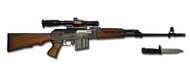
Unveiling the Saga: Exploring the Intricate History of Tabuk AK47s and Their Components
Posted by Peter Naroni - War Historian on Mar 26th 2024
In the realm of firearms, few names evoke as much reverence and fascination as the original Soviet AK47. But amidst the myriad variants that have emerged over the years, many great takes have been had on original. We've touched on many before and we continue on and today we touch on the Tabuk AK47. It too stands as a distinctive testament to ingenuity and adaptation. Join me for a quick look at the ultra unique history, lore, and stories surrounding the Tabuk AK47 and its integral components.
Origins of the Tabuk AK47: Originating in Iraq, where it was produced at the Al-Qadissiya Establishments using machinery and Yugoslavian assistance on the technical end (specifically Zastava Arms) in the late 1970s. Inspired by the OG AK47 design crafted by Soviet engineer Kalashnikov, needless to say I imagine, Iraqi engineers embarked on a quest to create a weapon tailored to the unique challenges of the desert landscape.
The end result after a few prototypes was an AK with several unique cultural attributes, from the emblems and engravings to the minor differenes in design. With its elongated barrel, sturdy wooden furniture, and robust construction, the Tabuk AK47 emerged as an extremely solid rifle capable of thriving in the harsh sandy environment.

One of the coolest elements of the Tabuk Sniper model is its elongated barrel, a departure from the standard AKM configuration. This modification not only enhances accuracy and muzzle velocity but also allows for improved long-range capabilities, crucial in the vast expanses of the desert. Paired with a rugged wooden stock and handguard, the Tabuk exudes a timeless elegance while retaining its functionality and durability.
Evolution and Variants: Over the decades, the Tabuk AK47 has evolved a bit but largely remains the same, adapting to changing warfare doctrines and technological advancements. Among the most notable variants is the Tabuk Sniper Rifle (Tabuk-S), a precision instrument tailored for long-range engagements.
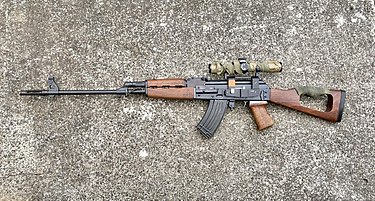
Equipped with a telescopic sight and meticulously calibrated to deliver pinpoint accuracy, the Tabuk-S embodies the pinnacle of marksmanship. Whether deployed in the arid plains or the urban jungles, this variant remains a favored choice among sharpshooters and special forces units.
In addition to specialized variants, modern iterations of the Tabuk AK47 incorporate cutting-edge materials and manufacturing techniques. From lightweight polymers to advanced coatings that enhance corrosion resistance, these enhancements ensure that the Tabuk remains at the forefront of firearms technology.
Parts and Accessories: Central to the allure of the Tabuk AK47 are its modular design and compatibility with a vast array of accessories and Tabuk aftermarket components. Enthusiasts and professionals alike revel in the opportunity to personalize their rifles, tailoring them to suit their individual preferences and mission requirements.
Key components such as the receiver, barrel, bolt carrier, and trigger mechanism serve as the foundation upon which the Tabuk's reliability and performance are built. Crafted with precision and attention to detail, these parts undergo rigorous testing to ensure optimal functionality and durability in the field.
From ergonomic grips and adjustable stocks to specialized optics and muzzle devices, the possibilities for customization are virtually limitless. Whether enhancing ergonomics, improving accuracy, or mitigating recoil, each accessory contributes to the overall effectiveness and versatility of the Tabuk AK.
Legacy and Influence: Beyond its role as a military firearm, the Tabuk AK has left an indelible mark on the cultural and geopolitical landscape of the Middle East. As a symbol of national pride and technological prowess, it embodied the spirit of innovation and self-reliance that defined the region. Especially in the Iraqi region which has been in somewhat of a non-stop war for several decades, unfortunately.
During the Iraqi wars, spanning from the Iran-Iraq War in the 1980s to the Gulf War in the 1990s and the Iraq War in the 2000s, the Tabuk AK47 played a significant role on the battlefields of the region. Its presence became ubiquitous among Iraqi forces and insurgent groups, shaping the course of conflicts and influencing military strategies.
- Iran-Iraq War (1980-1988): The Tabuk AK47 saw extensive use during the Iran-Iraq War, a protracted conflict characterized by trench warfare, chemical attacks, and large-scale offensives. Iraqi forces, armed with a diverse array of weaponry, including the Tabuk AK47, engaged in fierce battles against Iranian troops across the desolate landscapes of the border region.
As one of the primary infantry rifles employed by Iraqi soldiers, the Tabuk AK47 proved instrumental in sustaining prolonged engagements and defending strategic positions. Its rugged construction and reliability were particularly well-suited to the harsh desert conditions prevalent in the theater of operations.
- Gulf War (1990-1991): During the Gulf War, Iraqi forces faced off against a coalition of international military forces led by the United States. Despite being outmatched in terms of technology and firepower, Iraqi soldiers relied heavily on their trusty Tabuk AK47 rifles to hold their ground against the advancing coalition troops.
In the desert sands of Kuwait and Iraq, the Tabuk AK-7 became a symbol of Iraqi resistance, wielded by soldiers defending their homeland against overwhelming odds. While the outcome of the conflict ultimately favored the coalition forces, the Tabuk AK47 left an indelible mark on the collective memory of Iraqi veterans and civilians alike.
- Iraq War (2003-2011): The Tabuk AK47 continued to play a pivotal role during the Iraq War, which saw the overthrow of Saddam Hussein's regime and the subsequent insurgency against coalition forces. In the chaotic aftermath of the invasion, Iraqi insurgents, armed with an assortment of weapons, including Tabuk rifles, launched a relentless campaign against occupying forces and the newly established Iraqi government.
The Tabuk AK47's reputation for reliability and durability made it the weapon of choice for insurgents engaging in guerrilla warfare tactics such as ambushes, roadside bombings, and hit-and-run attacks. Its widespread availability and ease of use ensured that it remained a persistent threat to coalition forces throughout the protracted conflict.
Despite the eventual withdrawal of coalition forces and the establishment of a new government in Iraq, the legacy of the Tabuk AK-47 lives on in the annals of military history. Its enduring presence on the battlefields of the Iraqi wars serves as a testament to its adaptability, effectiveness, and significance in shaping the course of armed conflicts in the Middle East.
Throughout the often volatile history of the Middle East, the Tabuk AK47 has been a constant presence on the battlefield in several other regions as well. From the deserts of Saudi Arabia to the mountains of Afghanistan, it has played a pivotal role in shaping the course of conflicts and revolutions.
Moreover, the Tabuk AK47 has arguably transcended its military origins to become a cultural icon, often immortalized in films, literature, and art. Its rugged charm captured the imagination of thousands of enthusiasts and collectors worldwide, cementing its status as a timeless symbol of firepower and freedom.
Tabuk prodcution ran from roughly the late 1970s to 2003 when coalition forces toppled the production factories of Saddam's regime. All the factories were essentially looted and stripped down and sold to the highest bidders. After that time period, in the midst of a change of governments Iraq's state run arms manufacturing was shut down and mostly halted. Rifles that made it out during and before range from ultra rare, rare all the way to basic. The existing Tabuk models continue to draw new fans among the long-term enthusiasts, who respect and admire these unique and well-crafted rifles.
If you found that interesting check out our blog post on the hidden story behind Hungary's sleek AK variant!